The scientific profile
From the latest record: 2026-09-05.
Hymenium
Gills crowded; grey-pinkish when young, becoming brown with maturity
Cap
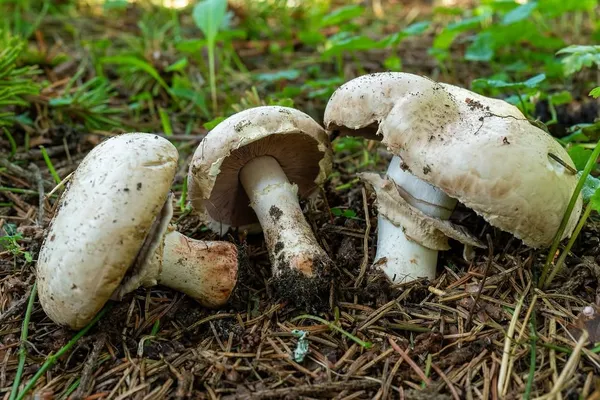
Hemispherical to convex when young, later broadly convex to flat or slightly depressed; cream, beige to brownish; smooth when young, with brownish scales; margin initially inrolled
Stipe
Short, very stout, solid, cylindrical to slightly tapering toward base; whitish, often browning below; thick sheathing ring
Spore print
Spore print chocolate-brown to dark brown
Ecology
Saprobic in grasslands, coastal dunes, sandy and saline soils, parks, roadsides and other disturbed urban habitats, notably where winter road salt accumulates; solitary or gregariously; summer to late autumn
Edibility
Edible but generally not highly valued
Fruit body
Fruit body medium to large; stipe ~4–8 cm long and ~2–5 cm thick
Flesh
White, thick and firm, turning pinkish-red to reddish-orange when cut or bruised, sometimes slowly
Chemical reactions
Schaeffer reaction negative
Odour
Variable; mild mushroomy or faintly anise-like when young, often becoming briny, iodine-like or fishy with age
Taste
Mild when young, sometimes unpleasant or iodine-like in mature specimens
Microscopy
Spores broadly ovoid to subglobose, smooth, thick-walled, dark brown, ~5.5–7.5 × 5–6 µm; basidia 4-spored; cheilocystidia abundant, clavate to cylindrical
Overview
Stout salt-tolerant Agaricus with coarse brownish scales and reddening flesh
1878). In Cooke & Quélet, Clavis Syn. Hymen. Europ. (London): 89.