19/Oct/24, 2:33 PM
Soodla jõgi, Harjumaa, Estonia
Spruce-pine-birch forest, in moss with pine needles
59°23'13.3"N 25°23'51.8"E
🔆 Clear sky, forest shade
Original Instagram postblushing amanita
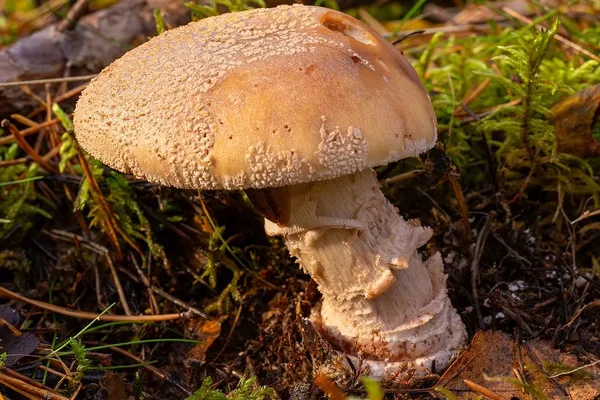
From the latest record: 2024-10-19.
Gills white to creamy-white, crowded, with numerous shorter lamellulae; developing pinkish to reddish stains when bruised or with age
Hemispherical to convex when young, later broadly convex to flat; highly variable, pale pinkish-brown, grey-brown, reddish-brown to dark brown; usually covered with irregular greyish-white, pinkish-grey to brownish universal-veil warts; margin generally non-striate
Adnate to nearly free
White to pale pinkish, cylindrical, often slightly enlarged or bulbous at base; progressively staining pink to wine-red when damaged; volva poorly developed and usually disappearing with age; membranous, pendulous ring distinctly striate on upper surface
Spore print white
Mycorrhizal with hardwoods and conifers; alone, scattered or gregariously; deciduous, coniferous and mixed forests; especially frequent on acidic, nutrient-poor soils; summer to autumn
Edible only after thorough cooking; poisonous raw, easily confused
Rubescenslysin, a thermolabile haemolytic/cytolytic protein toxin
Fruit body medium to large; stipe ~7–15 cm long and ~1–2(–3) cm thick
Cap ∅ ~5–20 cm
White, slowly turning pale pink, wine-red to reddish when cut, bruised or damaged, especially in the stipe base and around insect tunnels
No macroscopic reagents reaction
Mild, indistinct, mushroomy; sometimes unpleasant in old specimens
Mild, indistinct
Spores broadly ellipsoid to ovoid, smooth, hyaline, amyloid, ~8–10 × 5–7 µm; basidia predominantly 4-spored; clamp connections absent at basidial bases; lamellar trama bilateral
Brown-pink woodland Amanita characteristically blushing wine-red wherever damaged
1797). Tent. Disp. Meth. Fung. (Lipsiae): 67.
Soodla jõgi, Harjumaa, Estonia
Spruce-pine-birch forest, in moss with pine needles
59°23'13.3"N 25°23'51.8"E
🔆 Clear sky, forest shade
Original Instagram post#sonyalpha #amanita #amanitarubescens #blusher #blushingamanita #roosakärbseseen #kärbseseen #rötendewulstling #wulstling #mushroomphoto #fungiphoto #fungimacro #naturephotography #seenefotod #pilzefotografieren #фотогрибов #sieniäkuvia #forestwalk #mycology #fungistudy #mushroomhunt #mushroom #fungi #estonianfungi #amanitas #seened #pilze #champignon
Back to the collection · Photography and field notes by @fungarium.info