14/Sep/2026, 1:18 PM
Männiku, Tallinn, Harju, Eesti
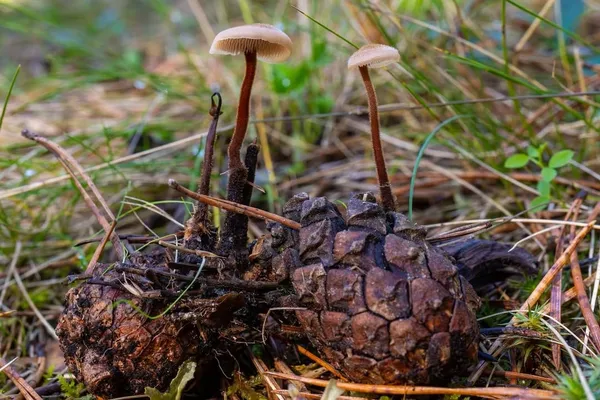
Pine forest, on Pinus sylvestris strobile buried in sandy soil
59°21'31.1"N 24°42'44.8"E
🌡️ 15°C ☀️ Sunny 💨 Wind 10° N->S, 9 km/h
Original Instagram postEarpick Fungus
From the latest record: 2026-09-14.
Teeth densely crowded, cylindrical and pointed, ~1–3 mm long; whitish when young, becoming pale brown to grey-brown with age
Kidney- to semicircular, broadly convex to flat; dry, finely bristly or hairy, sometimes smoother with age; reddish-brown, chestnut to nearly black, usually with a paler margin
Fertile teeth cover the underside of the cap
Slender, tough, lateral to strongly eccentric; reddish-brown to dark brown, densely hairy; often arising directly from a buried cone
Spore print white
Saprobic primarily on fallen and often partly buried pine cones, occasionally other conifer cones and litter; solitary or scattered; coniferous and mixed forests; summer to late autumn
Inedible; tiny, tough and leathery
Fruit body small; stipe ~2–7 cm long and up to ~0.3 cm thick
Cap ∅ ~1–3 cm
Whitish to brownish, thin, fibrous and tough, unchanging when cut
KOH instantly black on cap and stipe
Indistinct
Slightly bitter
Spores broadly ellipsoid to subglobose, finely warted to minutely spiny at maturity, hyaline, amyloid, ~4–6 × 3.5–5 µm; basidia 4-spored; cystidia fusoid, clamp connections present
Tiny dark tooth fungus growing characteristically from fallen pine cones
1821). Nat. Arr. Brit. Pl. (London) 1: 650.
Männiku, Tallinn, Harju, Eesti
Pine forest, on Pinus sylvestris strobile buried in sandy soil
59°21'31.1"N 24°42'44.8"E
🌡️ 15°C ☀️ Sunny 💨 Wind 10° N->S, 9 km/h
Original Instagram post#auriscalpiumvulgare #mushroomphotos #fungimacro #earpickfungus #naturephotography
Back to the collection · Photography and field notes by @fungarium.info