The scientific profile
From the latest record: 2026-07-25.
Hymenium
Pores angular, whitish to pale grey when young, becoming dingy brownish with age; sometimes bruising faintly brown; approximately 3–5 pores per mm
Cap
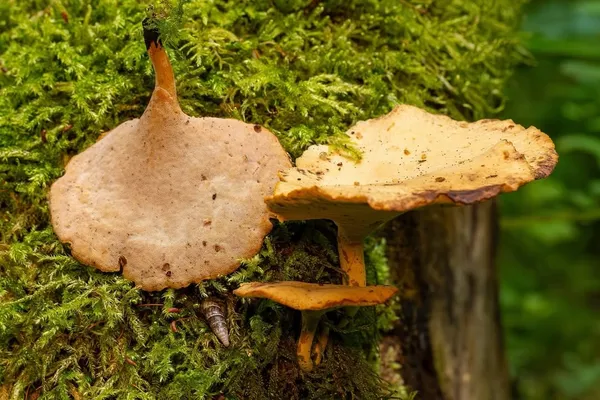
Plane-convex to flat, later centrally depressed with an uplifted margin; round to kidney-shaped; dry, smooth or finely radially fibrillose; dull yellow to pale tan, often radially streaked
Hymenium Attachment
Decurrent
Stipe
Central, eccentric or lateral, short and tough; pale near apex, becoming dark brown to black and finely velvety from the base upward
Spore print
Spore print white
Ecology
Saprobic, causing white rot on decaying hardwood sticks, fallen branches and small barkless logs; solitary or scattered; late spring to autumn
Ecology
Inedible, too tough, leathery and woody
Fruit body
Fruit body medium; stipe ~1–3 cm long and ~0.2–0.7 cm thick
Flesh
Flesh whitish to dull yellowish, thin, very tough
Chemical reactions
KOH brownish-orange on cap surface and flesh
Microscopy
Spores cylindrical, smooth, hyaline, inamyloid, ~6–10 × 2–3 µm; basidia 4-sterigmate; true cystidia absent, lageniform cystidioles present; hyphal system dimitic with clamped generative hyphae and thick-walled skeletal hyphae
Overview
Small pale stemmed polypore on dead hardwood, with radially streaked tan cap, decurrent whitish pores, stipe that progressively blackens upward from the base
1871). Führ. Pilzk. (Zerbst): 108.