The scientific profile
From the latest record: 2026-10-11.
Hymenium
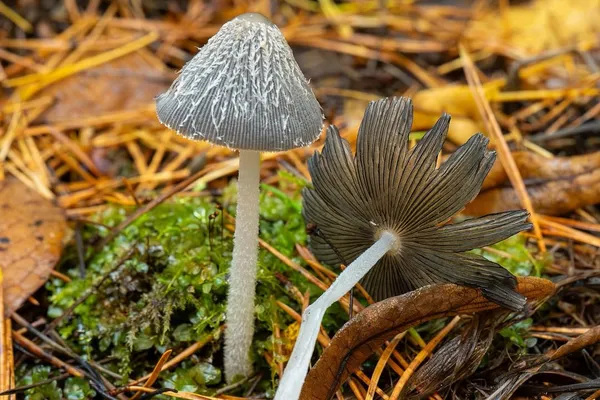
Gills crowded; white when young, becoming faintly reddish-grey, then grey-black
Cap
Ovoid when young, later conical, bell-shaped to flattened with upturned margin; grey-brown to dark grey; densely covered in ephemeral silvery-white woolly hairs when young, becoming smooth; strongly striate
Hymenium Attachment
Adnexed to free
Stipe
Slender, hollow and very fragile; white, initially covered with ephemeral white hairs, becoming smooth; ring absent
Spore print
Spore print violaceous-black to black
Ecology
Saprobic on humus-rich soil, leaf litter, decaying woody debris and woodchip mulch; solitary to densely gregarious; forests, woodland tracks and disturbed habitats; spring to late autumn
Edibility
Inedible; extremely fragile and insubstantial
Fruit body
Fruit body small; stipe ~4–10 cm long and ~0.3–0.6 cm thick
Dimensions
Cap ∅ ~1–3(–4) cm
Flesh
Whitish to greyish, extremely thin and fragile, rapidly collapsing as the gills deliquesce
Chemical reactions
No macroscopic reagents reaction
Microscopy
Spores ellipsoid to ovoid, smooth, dark, non-amyloid, ~10–14 × 6–8.5 µm, with acentral germ pore; basidia 4-spored with brachybasidia; pleurocystidia and cheilocystidia large
Overview
Woolly young inkcap rapidly transforming into a black deliquescent bowl
2001). In Redhead, Vilgalys, Moncalvo, Johnson & Hopple, Taxon 50(1): 229.