The scientific profile
From the latest record: 2026-09-19.
Hymenium
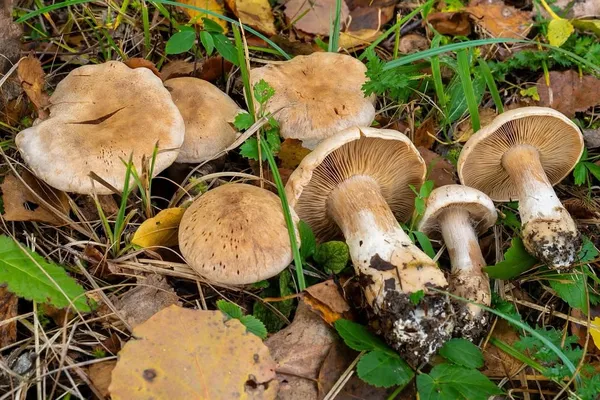
Gills crowded to fairly crowded, relatively narrow; pale beige-grey to clay-cinnamon; edges slightly paler
Cap
Convex when young, later broadly convex to almost plane, sometimes irregular or wavy; dry-looking, finely radial-fibrillose; sand-brown to ochre-tan with a darker centre and paler whitish margin
Hymenium Attachment
Emarginate to broadly adnate
Stipe
Robust, cylindrical to smoothly clavate; cream-white below, pale ochre-brown above; longitudinally fibrillose; base enlarged but not clearly marginate-bulbous; abundant white cobwebby cortina when young
Ecology
Presumably mycorrhizal; gregarious in a rich wooded meadow among aspen, birch, pine, hazel, oak and apple trees; Nedrema, Estonia; autumn
Edibility
Do not consume; exact species unresolved within a difficult Cortinarius–Phlegmacium complex
Fruit body
Fruit bodies medium to large and robust
Overview
Robust sand-brown Phlegmacium with crowded pale clay-coloured gills, a smoothly clavate pale stipe and conspicuous white cortina; provisionally cf. P. balteaticlavatum
Gray, S.F. (1821). A natural arrangement of British Plants. Volume I. Baldwin, London: i-xxvii, 1-821, 21 pls.