03/Sep/2026, 6:36 PM
Soodla forest, Anija, Harju, Eesti
Mixed (conifer dominant) forest woodland edge grassland (Pilosella sp.), in sandy soil
59°23'14.7"N 25°23'38.1"E
🌡️ 16°C ⛅ Partly sunny 💨 Wind 240° WSW->ENE, 20 km/h
Original Instagram postIndigo Pinkgill
From the latest record: 2026-09-03.
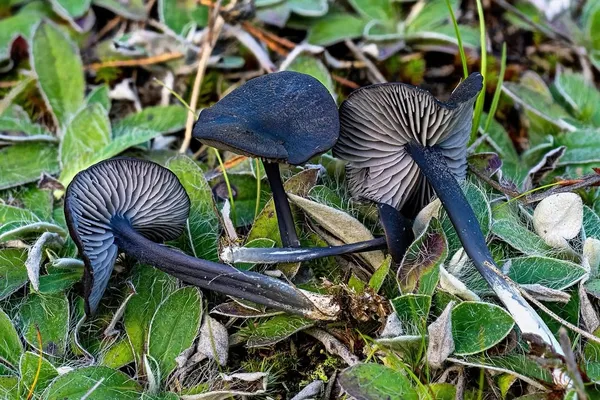
Gills moderately spaced, rather thick; whitish to pale grey when young, sometimes faintly bluish, becoming dirty salmon-pink with maturity
Convex to broadly convex, often shallowly umbilicate; finely velvety to minutely squamulose; dark steel-blue, blue-black to purplish-brown, sometimes becoming browner with age
Adnate to slightly emarginate
Slender, cylindrical to slightly flattened or longitudinally grooved; steel-blue to blue-black with longitudinal fibres, often paler toward apex; white tomentum at base; ring absent
Spore print pale pink to salmon-pink
Ecology saprotrophic(?); unimproved nutrient-poor grasslands, moist meadows, heathland and deciduous woodland; solitary, scattered or gregariously; summer to autumn
Inedible, potentially poisonous
Fruit body small; stipe ~3–7 cm long and ~0.2–0.5 cm thick
Cap ∅ ~1.5–5 cm
Grey-blue to pale bluish, thin, unchanging when cut
No macroscopic reagents reaction
Indistinct
Indistinct
Spores heterodiametrical, angular with 5–9 facets, ~8.5–12.5 × 6–8.5 µm; basidia 4-spored; cheilocystidia cylindrical to slender-clavate; pileipellis transitional between cutis and trichoderm; clamp connections absent
Dark steel-blue pinkgill with a finely velvety cap
1982). Nordic Jl Bot. 2(2): 162.
Soodla forest, Anija, Harju, Eesti
Mixed (conifer dominant) forest woodland edge grassland (Pilosella sp.), in sandy soil
59°23'14.7"N 25°23'38.1"E
🌡️ 16°C ⛅ Partly sunny 💨 Wind 240° WSW->ENE, 20 km/h
Original Instagram post#entolomachalybeum #mushroomphotos #fungimacro #indigopinkgill #naturephotography
Back to the collection · Photography and field notes by @fungarium.info