The scientific profile
From the latest record: 2026-10-03.
Hymenium
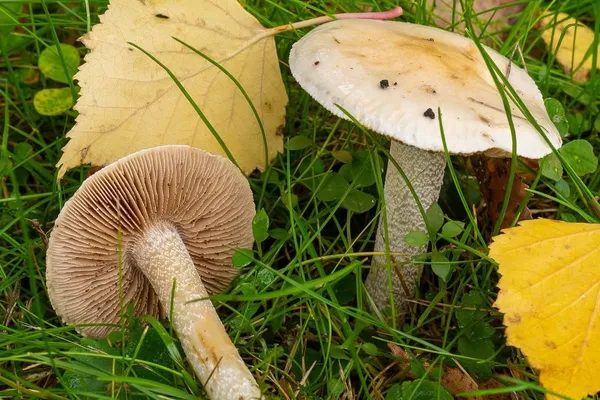
Gills crowded; whitish to pale cream when young, becoming clay- to cinnamon-brown with maturity; edges whitish
Cap
Convex when young, later broadly convex to flat, sometimes obtusely umbonate; smooth, viscid when moist; whitish-buff, pale tan, usually darker centrally and paler toward margin
Hymenium Attachment
Adnate to emarginate
Stipe
Cylindrical to slightly clavate, white to pale cream; pruinose or floccose-granular near apex, fibrillose below; base sometimes enlarged with white mycelial threads; ring absent
Spore print
Spore print reddish-brown to clay-brown
Ecology
Mycorrhizal with hardwoods and conifers; forests, woodland edges, dunes and grassy places beneath trees; solitary, scattered or gregariously; summer to late autumn
Edibility
Poisonous; causes gastrointestinal upset, including nausea, vomiting, abdominal pain and diarrhoea
Description
Gills often exuding clear droplets in moist weather that dry as rusty-brown spots
Fruit body
Fruit body medium to large; stipe ~4–13 cm long and ~0.5–2 cm thick
Flesh
White, thick and firm, unchanging when cut
Chemical reactions
No macroscopic reagents reaction
Microscopy
Spores amygdaloid, verrucose, yellow-brown, weakly dextrinoid, ~9–12 × 5–6.5 µm; basidia 4-spored; cheilocystidia abundant, clavate- to spathulate-stipitate; pleurocystidia absent; clamp connections present
Overview
Pale sticky poisonpie with weeping gills and radish-like odour
1872). Mém. Soc. Émul. Montbéliard, Sér. 2 5: 128.