The scientific profile
From the latest record: 2026-09-22.
Hymenium
Smooth to wrinkled or irregularly folded, covering the exposed upper surface of the saddle-shaped apothecium; ivory-white to cream or pale buff
Apothecium
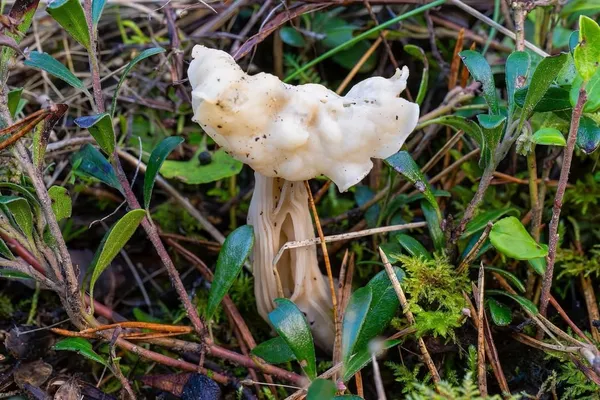
Irregularly saddle-, mitre- to lobed-shaped, usually with 2–4 strongly folded or curled lobes; whitish, ivory to pale cream; margin wavy
Hymenium Attachment
Ffertile surface exposed over the upper lobes
Stipe
Robust, white to cream, hollow and strongly longitudinally ribbed, fluted and chambered; ribs often branch and reconnect
Spore print
Spore print white
Ecology
Mycorrhizal, mainly with hardwoods such as beech and oak, occasionally with conifers; woodland, path edges and disturbed forest soil; solitary, scattered or gregariously; summer to late autumn
Edibility
Poisonous (hydrazine toxins); historically eaten after cooking
Uses & compounds
Gyromitrin and related hydrazine compounds
Fruit body
Fruit body medium to large; stipe ~4–10 cm long and ~0.8–3 cm thick
Dimensions
Apothecium ~3–8 cm wide
Flesh
Whitish; unchanging when cut
Chemical reactions
No macroscopic reagents reaction
Odour
Faint, mushroomy and slightly sweetish
Microscopy
Spores ellipsoid, smooth, hyaline, usually with one large central oil droplet, ~17–21 × 10–13 µm; asci cylindrical, 8-spored, ~220–300 × 12–18 µm, inamyloid;
Overview
Ivory saddle fungus with a deeply fluted hollow stipe
1822). Syst. Mycol. (Lundae) 2(1): 14.