The scientific profile
From the latest record: 2026-10-03.
Hymenium
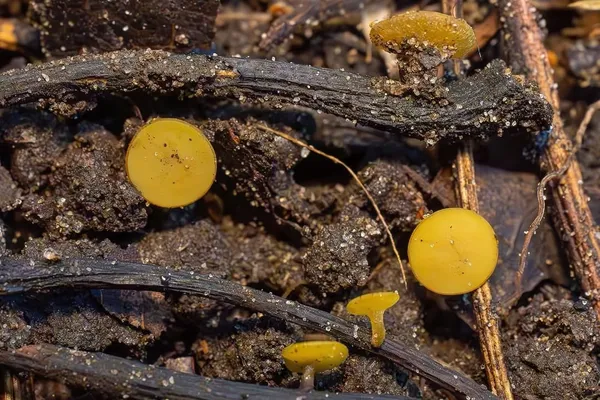
Smooth, pale yellow to egg-yellow, sometimes olive-yellow or ochraceous; becoming ochre-brown with age
Apothecium
Cup- to shallow disc-shaped, later nearly flat; fleshy-waxy, pale yellow to yellow-orange; often slightly reddening when damaged
Stipe
Very short to rudimentary, pale yellow to whitish; sometimes nearly sessile
Spore print
Spore print white
Description
Saprobic on decaying broadleaf litter, especially fallen leaves of oak, beech, maple, hornbeam and birch; also petioles and other small plant debris; scattered to densely gregarious; late summer to late autumn
Edibility
Inedible; tiny and without culinary value
Fruit body
Fruit body tiny; usually only a few millimetres tall
Dimensions
Apothecium ∅ ~0.5–3(–7) mm
Flesh
Pale yellow to whitish, thin and waxy; sometimes reddening slightly when damaged
Description
Paraphyses cylindrical with strongly refractive yellowish guttules
Microscopy
Ascospores asymmetric fusiform to narrowly ellipsoid, smooth, hyaline, usually ~15–23 × 3–5.5 µm, aseptate when young and occasionally septate when overmature, with several oil droplets; asci cylindrical, 8-spored, ~90–135 × 9–11 µm, apical pore amyloid
Overview
Tiny yellow-olive leaf-litter cup with slender fusiform spores
1929). Pap. Mich. Acad. Sci. 9: 177 (’1928′).