22/Sep/24, 2:35 PM
Tallinn Botanic Garden, Harjumaa, Estonia
Decaying deciduous hardwood stump
59°28'14.2"N 24°52'35.8"E
🔆 Sunny weather, deep forest shade
Original Instagram postbrittle cinder
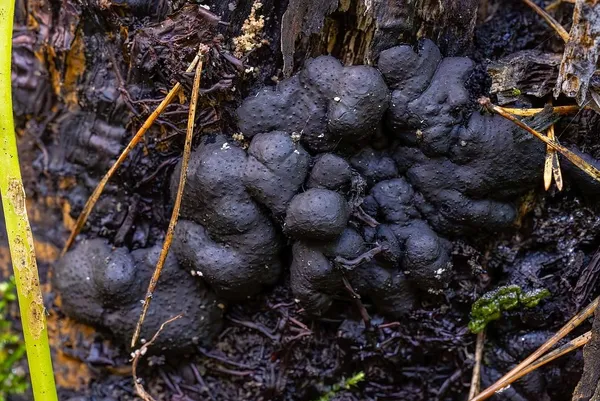
From the latest record: 2024-09-22.
Typically located on the irregular, crust-like surface of the fruiting body, dark gray to black, turning powdery or ash-like with age
Lacks a true cap, forms as an encrusting, flattened mass that adheres closely to the substrate, often with a rough, cracked, or uneven texture, initially pale gray to dark gray, becoming black with age
N/A
N/A
Spore print black
Parasitic and saprobic, primarily on hardwoods, causes white rot decay in living trees, on dead wood or decayed sections of living trees, throughout the growing season
Inedible, known to be toxic
Fruiting body crust-like, spreading, often covering areas up to 10–30 cm in diameter
Thickness 0.5–1.5 cm thick
KOH negative, does not react visibly with common reagents
Odour indistinct or slightly unpleasant when fresh
Taste not reported
Spores ellipsoid, smooth, 16–30 x 5–9 µm, black in mass, hyaline to slightly tinted individually
Crust-like, black, and brittle fungus that causes a destructive white rot
Jl S. Afr. Bot. 36(2): 80
Tallinn Botanic Garden, Harjumaa, Estonia
Decaying deciduous hardwood stump
59°28'14.2"N 24°52'35.8"E
🔆 Sunny weather, deep forest shade
Original Instagram post#sonyalpha #kretzschmaria #kretzschmariadeusta #brittlecinder #woodfungi #hariliklamesüsik #lamesüsik #brandkrustenpilz #karstasyylä #mushroomphoto #fungiphoto #fungimacro #naturephotography #seenefotod #pilzefotografieren #фотогрибов #sieniäkuvia #forestwalk #mycology #fungistudy #mushroomhunt #mushroom #fungi #estonianfungi #грибы #seened #pilze #champignon
Back to the collection · Photography and field notes by @fungarium.info