The scientific profile
From the latest record: 2026-08-30.
Hymenium
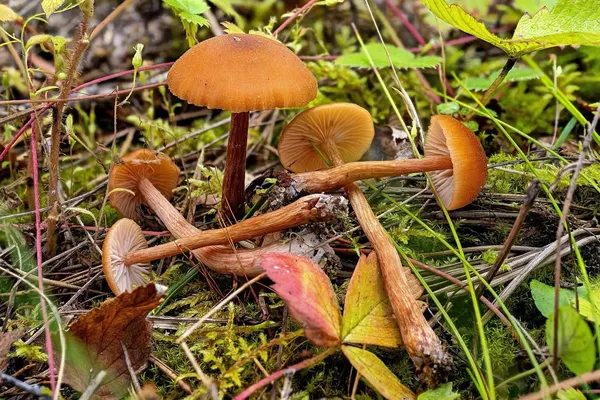
Gills thick, broad and moderately distant; pinkish-flesh to salmon or pale reddish-brown, becoming paler as spores mature
Cap
Convex when young, later broadly convex to flat or centrally depressed; smooth to finely fibrillose; orange-brown, reddish-brown to tan when moist, fading to almost whitish when dry
Hymenium Attachment
Adnate to slightly decurrent
Stipe
Slender, tough and fibrous, cylindrical or tapering toward base; coloured similarly to cap, becoming paler when dry; finely hairy toward base with white basal mycelium; ring absent
Spore print
Spore print white
Ecology
Mycorrhizal with hardwoods and conifers; alone, scattered or gregariously; forests, woodland edges and heathland; summer to late autumn
Edibility
Edible but modest; caps usable, stems tough and fibrous
Fruit body
Fruit body small to medium; stipe ~2–10 cm long and ~1 cm thick
Flesh
Thin, pale orange-brown to buff, unchanging when cut
Chemical reactions
No macroscopic reagents reaction
Odour
Mild, indistinct to faintly radish-like
Taste
Mild to faintly radish-like
Microscopy
Spores globose to subglobose, strongly echinulate, ~7–10 µm, with spines ~1–2 µm tall; hyaline, inamyloid; basidia 4-spored; cheilocystidia filamentous to subclavate; pileipellis a cutis
Overview
Highly variable orange-brown woodland deceiver with thick pinkish gills
1884). Grevillea 12(no. 63): 70.