The scientific profile
From the latest record: 2026-10-04.
Hymenium
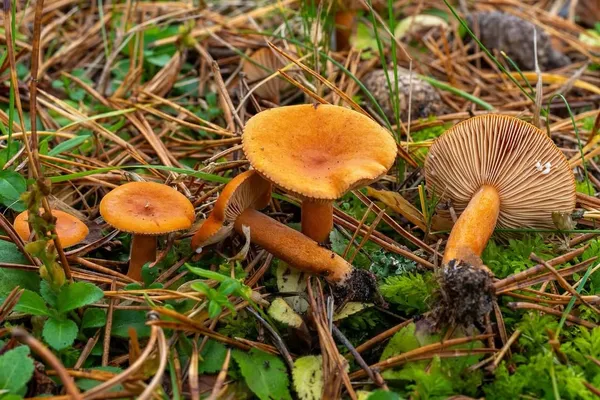
Gills moderately spaced; whitish to cream when young, becoming pinkish-buff to pale ochre
Cap
Convex when young, later broadly flat to shallowly depressed; smooth, dry to slightly glossy; vivid orange, orange-red to orange-brown; unzoned, margin initially inrolled
Hymenium Attachment
Broadly adnate to shortly decurrent
Stipe
Cylindrical to slightly clavate, smooth, orange-brown to yellow-orange, usually paler near apex; becoming hollow with age; ring absent
Spore print
Spore print ivory to pale cream
Ecology
Mycorrhizal mainly with spruce and pine, occasionally birch and other hardwoods; coniferous and mixed forests, often on acidic soils; solitary, scattered or gregariously; summer to late autumn
Edibility
Edibility disputed; generally not recommended
Fruit body
Fruit body small to medium; stipe ~2.5–7 cm long and ~0.5–1.2 cm thick
Dimensions
Cap ∅ ~1–5(–7) cm
Flesh
Whitish to pale orange, brittle; abundant white latex unchanging, mild
Chemical reactions
Guaiac grey-green; FeSO₄ grey-green on flesh
Odour
Faint, slightly unpleasant, rubbery
Taste
Mild, slightly bitter, radish-like
Microscopy
Spores broadly ellipsoid to subglobose, ~7–9.5 × 6–7.5 µm, ornamented with low amyloid warts and connecting ridges; numerous fusoid cystidia
Overview
Small vivid orange milkcap with immutable white latex
1821). Nat. Arr. Brit. Pl. (London) 1: 624.