The scientific profile
From the latest record: 2026-09-19.
Hymenium
Gills crowded, narrow; whitish to cream when young, becoming cream-ochre to yellowish
Cap
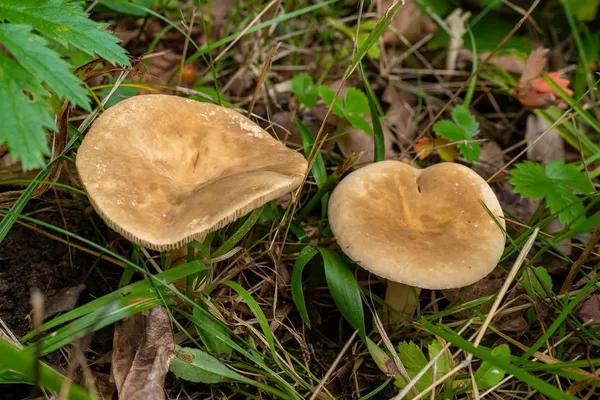
Convex when young, later flat to centrally depressed; dry, matte, finely pruinose to velvety; pale ochre, grey-brown to smoky brown, often irregularly paler toward margin; unzoned
Hymenium Attachment
Adnate to slightly decurrent
Stipe
Cylindrical, often tapering toward base; initially white to whitish, later cream-grey; smooth to finely pruinose; becoming hollow with age
Spore print
Spore print pale cream to ochre, sometimes pinkish-buff
Ecology
Mycorrhizal with hardwoods, especially oak and chestnut, also beech; deciduous forests, parks and woodland edges, on calcareous soil; scattered to gregariously; summer to autumn
Edibility
Edibility disputed, taste becoming acrid
Fruit body
Fruit body small to medium; stipe ~3–7 cm long and ~0.5–1.5 cm thick
Flesh
Whitish to cream, brittle, turning salmon-pink to pink-orange within minutes when cut; abundant white latex also stains gills and flesh pink but remains white when isolated
Chemical reactions
Guaiac rapidly blue-green; KOH negative on flesh and latex; FeSO₄ weak to nearly negative
Odour
Faint, pleasantly fruity, coconut-like
Taste
Mild initially, then slightly bitter to acrid
Microscopy
Spores globose to subglobose, ~7–9 × 6–8.5 µm, ornamented with amyloid warts and ridges; basidia 4-spored; cheilomacrocystidia abundant, fusiform with elongated necks; pileipellis a trichoderm
Overview
Pale unzoned milkcap with white stipe and characteristic salmon-pinking flesh
1838). Epicr. Syst. Mycol. (Upsaliae): 343 (’1836-1838′).