The scientific profile
From the latest record: 2026-09-19.
Hymenium
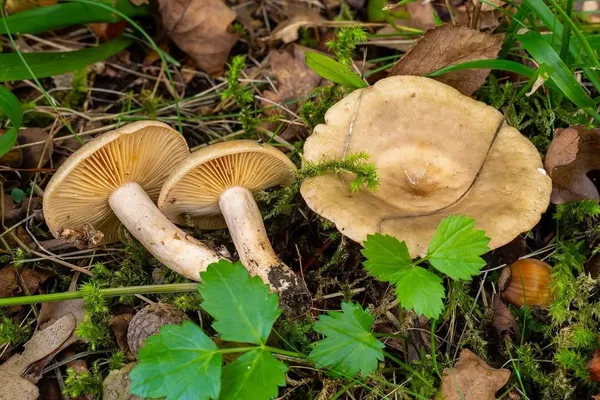
Gills moderately spaced to distant; pale yellow to ochre-yellow when young, becoming orange-ochre with age
Cap
Convex when young, later centrally depressed to funnel-shaped; smooth, slightly viscid when moist; grey, grey-brown to grey-ochre, sometimes with olive or lilac tints; weakly zoned
Hymenium Attachment
Adnate to slightly decurrent
Stipe
Cylindrical to slightly tapering toward base; pale grey-brown to buff, usually paler than cap; smooth, becoming hollow with age; ring absent
Spore print
Spore print pale ochre to yellowish-ochre
Ecology
Mycorrhizal almost exclusively with hazel; deciduous and mixed woodland, coppices, hedgerows and woodland edges; solitary, scattered or gregariously; summer to autumn
Edibility
Inedible, acrid latex
Fruit body
Fruit body small to medium; stipe ~2.5–6.5 cm long and ~0.8–2 cm thick
Flesh
Whitish to pale grey, brittle; abundant white latex, drying yellow-olive to grey-green on damaged gills
Chemical reactions
KOH turns latex yellow-orange to golden yellow; FeSO₄, NH₄OH and phenol negative
Odour
Faintly fruity to apple-like
Taste
Extremely acrid, burning
Microscopy
Spores broadly ellipsoid, ~6.5–8 × 5–7 µm, ornamented with amyloid warts and broad connecting ridges forming an incomplete zebra-like network; basidia 4-spored; pleurocystidia fusiform to ventricose
Overview
Grey hazel milkcap with distant yellow gills and fiercely burning white latex
1838). Epicr. Syst. Mycol. (Upsaliae): 339 (’1836-1838′).