The scientific profile
From the latest record: 2026-09-19.
Hymenium
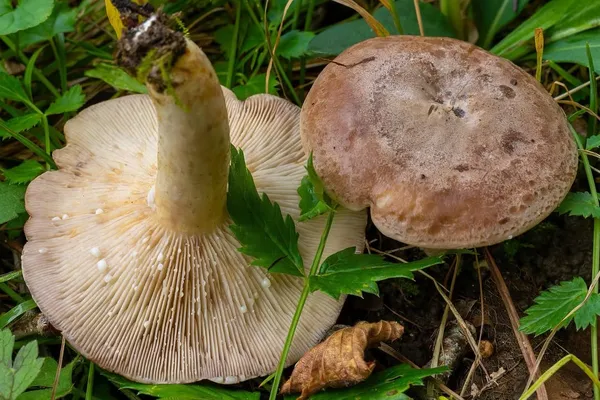
Gills fairly crowded; whitish to pale cream when young, becoming pale buff with age
Cap
Convex when young, later flat to shallowly depressed; smooth, viscid to slimy when fresh; pale violet-grey, lilac-grey to buff-brown, darkening with age; unzoned or faintly zoned
Hymenium Attachment
Adnate to shortly decurrent
Stipe
Cylindrical, pale cream to whitish, smooth, sometimes slightly viscid when young; becoming hollow with age; ring absent
Spore print
Spore print pale cream to pale yellowish
Ecology
Mycorrhizal mainly with birch and willow; damp woodland, bog margins and mossy acidic soils; solitary to gregariously; summer to autumn
Edibility
Not recommended; bitter, regarded as potentially poisonous
Fruit body
Fruit body small to medium; stipe ~3–7 cm long and ~0.6–2.5 cm thick
Flesh
Whitish to buff, firm and brittle; white latex and exposed flesh slowly stain lilac
Chemical reactions
KOH green on cap surface
Odour
Faintly fruity, indistinct
Taste
Mild initially to bitter
Microscopy
Spores subglobose to broadly ellipsoid, ~7.5–11 × 6.5–8.5 µm, ornamented with amyloid broad ridges ~0.5–1 µm high forming an incomplete reticulum; pleuro- and cheilomacrocystidia fusiform to subventricose; pileipellis an ixocutis
Overview
Slimy lilac-grey milkcap with white latex staining intensely violet-purple
1838). Epicr. Syst. Mycol. (Upsaliae): 338 (’1836-1838′).