The scientific profile
From the latest record: 2026-05-16.
Hymenium
Fertile surface smooth, lining deep pits and honeycomb-like depressions; ridges sterile, pale cream to yellow-ochre, darkening slightly with age
Cap
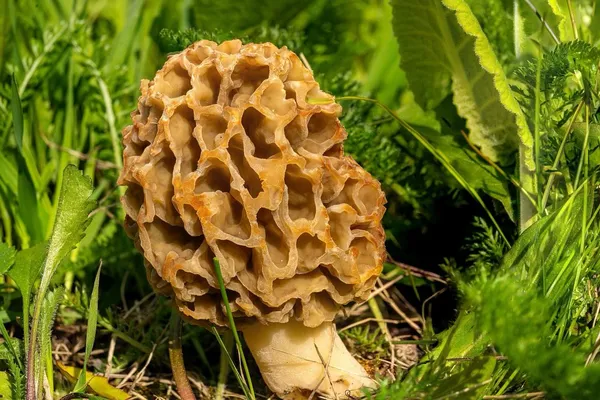
Ovoid to broadly conical, hollow, attached to stipe at the lower margin; surface strongly pitted and ridged, yellowish, ochre, tan to pale brown
Hymenium Attachment
Apothecial, fused to the stipe along the lower cap margin
Stipe
Cylindrical to clavate, hollow, whitish to cream, finely granular or furfuraceous, sometimes broadened at the base
Spore print
Spore print white to pale cream
Ecology
Facultatively mycorrhizal (hardwoods, conifers, grass plants), in woodlands, meadows, orchards, disturbed ground and calcareous soils
Edibility
Choice edible after thorough cooking, toxic raw/insufficiently cooked
Fruit body
Fruit body medium to large, stipe ~2–9 × 2–5 cm
Dimensions
Cap ∅ ~2–7 cm, height ~2–10 cm
Flesh
Thin, brittle, whitish to pale cream, hollow, unchanging when cut
Chemical reactions
No KOH reaction
Odour
Pleasant, earthy to faintly spermatic
Taste
Mild, nutty, rich when cooked (dried)
Microscopy
Spores ellipsoid, smooth, hyaline, ~17–22 × 9–11 µm, asci cylindrical, 8-spored, ~220–350 × 16–20 µm, paraphyses filiform to slightly enlarged apically
Overview
Classic honeycomb-like yellow-brown morel
1794). Neues Mag. Bot. 1: 116.