The scientific profile
From the latest record: 2026-10-11.
Hymenium
Gills moderately spaced; white to cream when young, becoming faintly pinkish with age; edges sometimes gelatinous
Cap
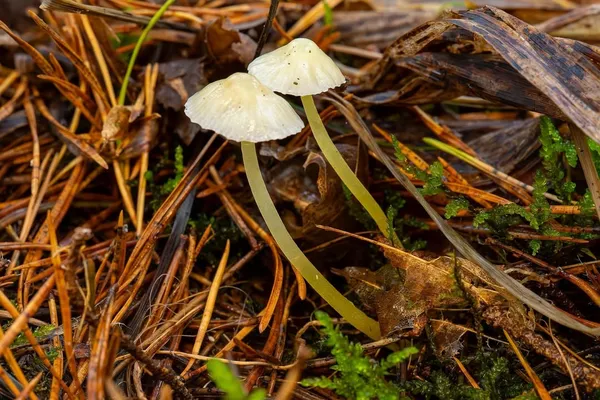
Conical to bell-shaped when young, later broadly convex to nearly flat; smooth, strongly viscid when moist, with a separable gelatinous pellicle; pale yellowish-grey; margin distinctly translucent-striate
Hymenium Attachment
Adnate to slightly decurrent, often with a short decurrent tooth
Stipe
Very slender, cylindrical, hollow and fragile; lemon-greenish-yellow; smooth, viscid, covered with a separable gelatinous layer; ring absent
Spore print
Spore print white to very pale cream
Ecology
Saprobic on conifer needle litter, moss, decaying twigs, woody debris; mainly spruce and pine forests, also mixed woodland, damp grassland and heathland; scattered to gregariously; late summer to autumn
Edibility
Not recommended; tiny, fragile and insubstantial
Fruit body
Fruit body small; stipe ~3–8 cm long and ~0.1–0.3 cm thick
Flesh
Flesh whitish, pale yellowish, very thin and fragile, unchanging when cut
Chemical reactions
No macroscopic reagents reaction
Odour
Faintly mealy, iodine-like
Microscopy
Spores ellipsoid to cylindrical, smooth, hyaline, amyloid, ~8–11 × 4–6 µm; basidia 4-spored; cheilocystidia irregularly clavate with numerous finger-like projections; pleurocystidia absent; pileipellis an ixocutis
Overview
Tiny slimy woodland bonnet with a bright yellow-green stipe and peelable gelatinous cap skin
1821). Nat. Arr. Brit. Pl. (London) 1: 619.