The scientific profile
From the latest record: 2026-10-03.
Hymenium
Gills moderately spaced; white to pale grey when young, often becoming pinkish-grey with age; short lamellulae frequent, cross-veins often developing between mature gills
Cap
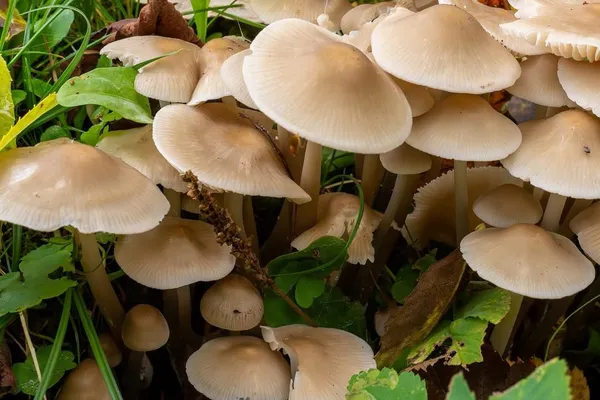
Conical to bell-shaped when young, later broadly convex to nearly flat with a persistent low umbo; smooth to slightly rugose, translucent-striate toward margin; grey-brown, darker centrally and paler toward margin
Hymenium Attachment
Adnate to emarginate, sometimes with a short decurrent tooth
Stipe
Slender, hollow, tough and elastic; whitish near apex, grey-brown to dark brown below; base with coarse white fibrils, rooting into decayed wood; ring absent
Spore print
Spore print white
Ecology
Saprobic on well-decayed hardwood logs, stumps, fallen branches and buried wood; solitary to densely clustered; late spring to late autumn
Edibility
Edible but insubstantial
Fruit body
Fruit body small to medium; stipe ~4.5–11(–18) cm long and ~0.15–0.6 cm thick
Dimensions
Cap ∅ ~2–6.5 cm
Flesh
Whitish to pale grey, thin and fragile, unchanging when cut
Chemical reactions
KOH negative on cap surface
Odour
Indistinct to faintly mealy
Microscopy
Spores broadly ellipsoid to pip-shaped, smooth, amyloid, ~9–12 × 6–8 µm; basidia 2- or 4-spored; pleurocystidia absent; clamp connections present in 4-spored forms
Overview
Large grey-brown wood bonnet with pinking gills and a tough rooting stipe
1821). Nat. Arr. Brit. Pl. (London) 1: 619.