The scientific profile
From the latest record: 2026-10-11.
Hymenium
Gills crowded, narrow; cream to pale yellow when young, becoming ochre-brown with maturity, sometimes with olive tones; edges often whitish
Cap
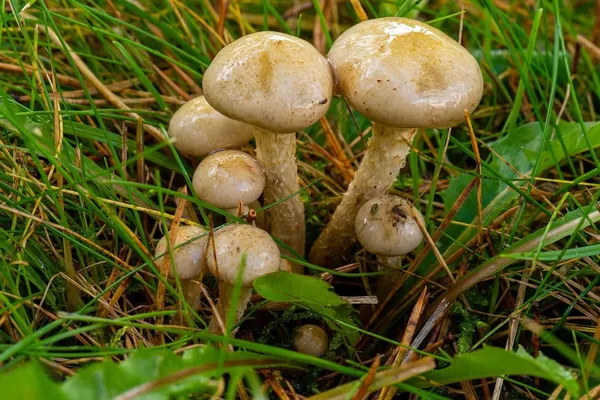
Hemispherical to convex when young, later broadly convex to nearly flat, with a low umbo; sticky to viscid when moist; cream-yellow, straw-yellow to pale ochre with olive-greenish tints; margin fringed with veil remnants
Hymenium Attachment
Adnate to slightly decurrent
Stipe
Cylindrical, cream to pale yellowish, becoming brownish toward base; finely pruinose near apex, covered with whitish to yellow-brown fibrils or small scales below; partial veil leaving a fragile ring or indistinct ring zone
Spore print
Spore print brown to rusty-brown
Ecology
Saprobic on decaying hardwood, especially buried roots, stumps and woody debris; in grass, parks, gardens and woodland paths; solitary, scattered or clustered; summer to late autumn
Edibility
Not recommended; little culinary value
Fruit body
Fruit body small to medium; stipe ~3–10 cm long and ~0.5–1 cm thick
Flesh
Whitish to pale yellowish, thin, unchanging when cut
Chemical reactions
No macroscopic reagents reaction
Odour
Slightly sweetish, mushroomy
Microscopy
Spores ellipsoid to oblong or slightly bean-shaped, smooth, yellow-brown, ~5.5–8 × 3.5–4.5 µm; basidia predominantly 4-spored; cheilocystidia cylindrical to lageniform; pileipellis an ixocutis
Overview
Pale yellow sticky scalycap with darker appressed scales, often growing from buried hardwood
1951). Lilloa 22: 517 (’1949′).