20/Aug/23, 3:47 PM
Raudoja, Harju County
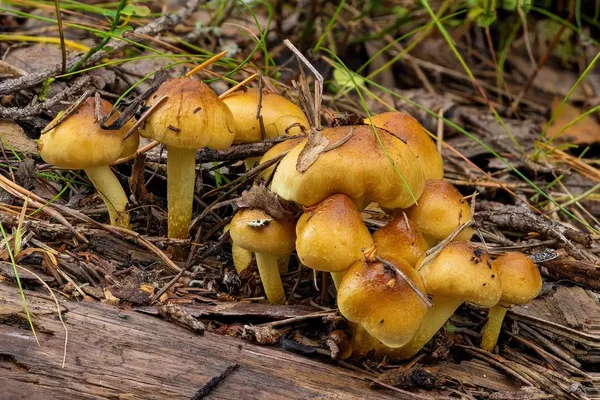
Mixed forest (pine, spruce, birch, willow), in decaying pine remains on forest road
59°22'46.2"N 25°28'58.9"E
🔆 Fair weather with slight overcast and occasional sun
Original Instagram postSlender Pholiota
From the latest record: 2023-08-20.
Gills are adnate to subdecurrent, close, and yellowish, turning brownish with age.
Up to 10 cm in diameter.Convex to flat, with a somewhat slimy, scaly surface; yellow-brown to dark brown.
Adnate to subdecurrent.
Cylindrical, yellowish at the top and brownish toward the base, sometimes with a ring.
Spore Print: Brown.
Saprobic, growing on decaying wood or on wood chips and sometimes on the ground.
Inedible; not recommended for consumption.
Up to 12 cm tall.
Microscopic Features: Spores are elliptical, smooth, and measure approximately 6-8 x 4-5 µm.
Earthy, not distinctive.
Known for its distinctive brown spore print and a cap that varies from yellow-brown to dark brown, Pholiota spumosa is primarily saprobic, thriving on decaying wood.
1948). Sydowia 2(1-6): 39.
Raudoja, Harju County
Mixed forest (pine, spruce, birch, willow), in decaying pine remains on forest road
59°22'46.2"N 25°28'58.9"E
🔆 Fair weather with slight overcast and occasional sun
Original Instagram post#fungi #photo #sonyalpha #pholiotaspumosa #slenderpholiota #mampel #pholiota #männimampel #macro #mushroom #fungifun #forestwalk #mycology #naturephotography #inediblefungi #mushroomhunt #raudoja #seened #eestiseened #Nadelschüppling #fungistudy #schüppling #foto #pilze #seenefotod #pilzefotografieren #фотогрибов #champignon
Back to the collection · Photography and field notes by @fungarium.info