03/Sep/23, 3:43 PM
Kadriorg, Tallinn, Harju County
On dying European horsechestnut tree (Aesculus hippocastanum), near road
59°26'33.3"N 24°47'37.1"E
🔆 Bright sun after the rain, sunny spot
Original Instagram postSplitgill
From the latest record: 2023-09-03.
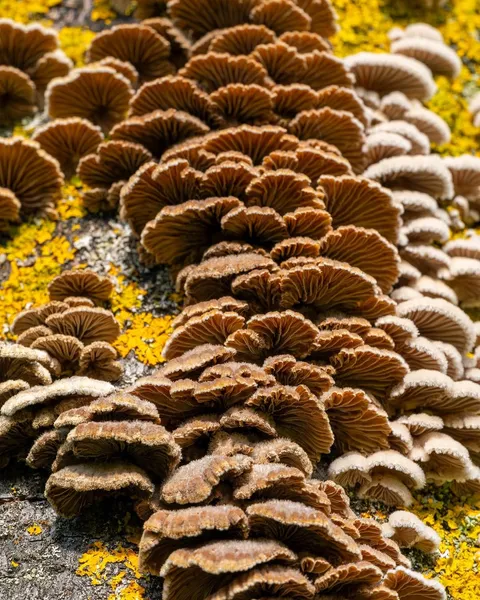
Gills are split longitudinally, whitish to pale gray, and quite unique in their appearance.
1-4 cm in diameter. Fan-shaped to nearly circular, wavy, and whitish to grayish.
Decurrent to somewhat attached.
Generally absent or very short, when present.
Spore Print: White.
Saprobic; grows on decaying wood and logs in a variety of environments, from forests to urban settings.
Inedible due to its tough, woody texture.
Generally 1-4 cm across.
Spores are cylindrical to ellipsoidal, smooth, and hyaline.
Not distinctive or woody.
Widespread fungus notable for its unique split gills. The species is found worldwide, making it one of the most ubiquitous fungi. It has been studied for its cellulose-degrading enzymes and potential medical applications, such as antimicrobial properties.
1815). Observ. Mycol. (Havniae) 1: 103.
Kadriorg, Tallinn, Harju County
On dying European horsechestnut tree (Aesculus hippocastanum), near road
59°26'33.3"N 24°47'37.1"E
🔆 Bright sun after the rain, sunny spot
Original Instagram post#fungi #photo #sonyalpha #schizophyllumcommune #splitgill #pathogen #schizophyllum #lõhislehik #macro #mushroom #грибы #forestwalk #mycology #naturephotography #saprobicfungi #mushroomhunt #kadriorg #seened #eestiseened #gemeinerspaltblättling #fungistudy #spaltblättling #foto #pilze #seenefotod #pilzefotografieren #фотогрибов #champignon
Back to the collection · Photography and field notes by @fungarium.info