18/Sep/24, 3:13 PM
Raudoja, Harjumaa, Estonia
Coniferous forest, on Cribaria sp. slime mold
59°22'44.8"N 25°29'06.9"E
🔆 Mild overcast, partial forest shade
Original Instagram post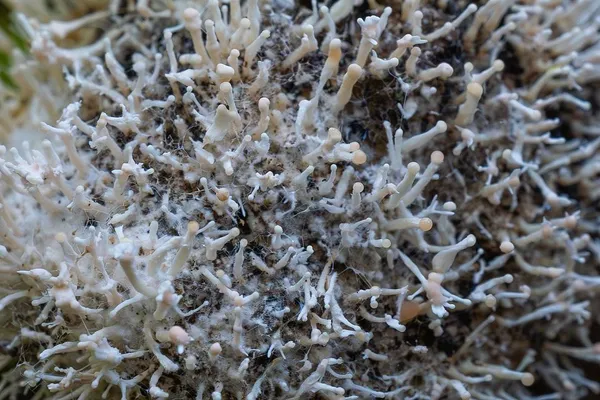
From the latest record: 2024-09-18.
N/A
N/A; this is a conidial (asexual) fungus and does not form a typical mushroom cap.
N/A
N/A
N/A (spores are produced asexually).
Parasitic, grows parasitically on the fruiting bodies (sporangia) of slime molds in the genus Cribaria, found in moist, forested environments where slime molds occur, invades and consumes the slime molds, often appearing as fine, hair-like mycelium covering their sporangia
Edibility: Not edible.
Stilbella byssiseda does not form typical mushroom fruit bodies. Instead, it produces minute, thread-like structures (conidiophores) that emerge on the surface of parasitized slime molds.
N/A
N/A
Conidiophores are filamentous, septate, bear cylindrical conidia, 6–12 x 2–3 µm
Parasitic fungus that targets slime molds in the genus Cribaria
1985). Stud. Mycol. 27: 61.
Raudoja, Harjumaa, Estonia
Coniferous forest, on Cribaria sp. slime mold
59°22'44.8"N 25°29'06.9"E
🔆 Mild overcast, partial forest shade
Original Instagram post#sonyalpha #stilbella #stilbellabyssiseda #parasiteonslimemold #parasiticfungi #gljiva #houba #asexualfungi #grzyb #mushroomphoto #fungiphoto #fungimacro #naturephotography #seenefotod #pilzefotografieren #фотогрибов #sieniäkuvia #forestwalk #mycology #fungistudy #mushroomhunt #mushroom #fungi #estonianfungi #sordariomycetes #seened #pilze #champignon
Back to the collection · Photography and field notes by @fungarium.info