The scientific profile
From the latest record: 2026-10-04.
Hymenium
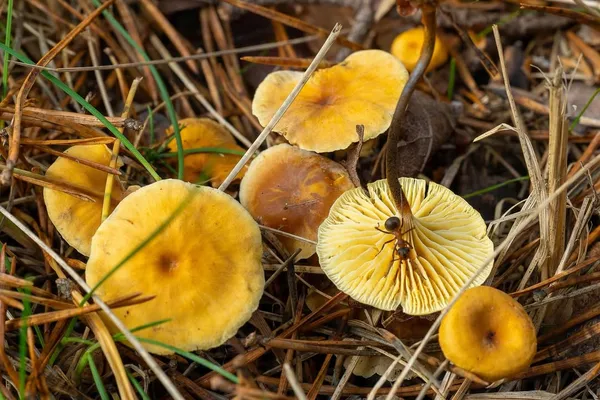
Gills moderately spaced, interveined; pale yellow to yellow-ochre, becoming slightly orange-ochre with age
Cap
Convex when young, later broadly convex to nearly flat with a shallow central depression or umbilicus; smooth, hygrophanous, slightly viscid when moist; yellow-ochre, orange-brown, usually darker centrally
Hymenium Attachment
Adnate to shortly decurrent
Stipe
Very slender, tough and wiry; yellow-ochre near apex, dark reddish-brown to chestnut below; finely tomentose, with ochre to tawny basal mycelium; ring absent
Spore print
Spore print white
Ecology
Saprobic on conifer needle litter, twigs and woody debris; coniferous and mixed forests; scattered to densely gregarious; summer to autumn
Edibility
Inedible; bitter and insubstantial
Fruit body
Fruit body small; stipe ~2.5–8 cm long and ~0.1–0.25 cm thick
Dimensions
Cap ∅ ~0.5–2.5 cm
Flesh
Yellowish to orange-brown, very thin and pliant, unchanging when cut
Chemical reactions
No macroscopic reagents reaction
Odour
Distinctive and pleasant scent reminiscent of Moneses uniflora
Taste
Mild, distinctly bitter
Microscopy
Spores ellipsoid to broadly ellipsoid, smooth, hyaline, amyloid, ~5.5–8 × 3–4 µm; basidia 4-spored; cheilocystidia abundant, fusoid to clavate; caulocystidia present; clamp connections present
Overview
Tiny orange-brown conifer-litter omphalinoid with a wiry dark stipe
1934). Bull. Trimest. Soc. Mycol. Fr. 50: 18.